Rainy Days are so full of inspiration!! The clouds open up making their mark on the world…when the clouds break free so do my thoughts! #cheesyphrase
A teaser of today’s doings! The title is assigned and a new chapter has evolved – progression!


Rainy Days are so full of inspiration!! The clouds open up making their mark on the world…when the clouds break free so do my thoughts! #cheesyphrase
A teaser of today’s doings! The title is assigned and a new chapter has evolved – progression!

Like all successful stories, the reader is unable to imagine the writer’s words without a form of scenery or setting taking place. One that oozes of fantastic atmosphere, rich with excitement and drama. Whether it’s an epic battle taking place in a far away galaxy. Or a romantic picnic by the riverside, scenes are key to be able to visualise the full effect, a place where you can see your characters play their part.
You are staging this story, how do you want your audience to see it?
A scene within photography follows a similar procedure. How would you want your viewer to see what you want them to see. A digital eye differs from the human eye, therefore it is the photographer’s job to structure the scene laid out in front of them into what they want the viewer to see. How a writer would have to consider the use of adjectives, similes, writing style in describing a scene whereas the photographer would substitute the use of words by working with lighting, angles and depth of field to produce the scene.
An experiment I conducted about the contrast and comparison of scenery between writer and photography is shown below:
DESCRIPTION:
They strode, swiftly and sweetly. With hair as black as a Raven’s feather, the two girls tiptoed and teetered along the concrete path without a glance backwards. Their white dresses billowed behind them in the cool, Spring air. They proceeded with their assigned role, bringing justice to the role of Bridesmaid in between the elegant architecture of a wooden cross-hatched fence. Dim shoots of light entered through the diamond constructed patterns of the fence, creating barely visible shadows. It enclosed them in narrowly as they walked away, delving deeper into the caged tunnel.
Do you have an image in your mind? Hopefully it looks similar to this:
PHOTOGRAPH:

Writing Exercise:
Create and describe your own scene, anything you want. Add characters if you wish. Use any form of writing method you feel comfortable with but remember to think about your audience, what do you want them to visualise? After this take on the task of capturing this scene with a camera, a from as professional as DSLR or as simple as a camera phone – the choice is yours! But try to capture the aspects of this scene of how you wrote it, turn the written word into a reality. However, is this proves to be difficult swap it around – take the photograph of desired scene and then write about it. Allow the visual imagery to be converted into words.
Living with an Arabic name in the Western World. There is bound to be some confusion there, if you have an awkward name just do what I did – write a poem about it.
Fake Paradise
‘Iran’ was scrawled ever so credulously on the side of my Starbucks cup.
Sigh.
The smiley face doodled aside it was obviously
Mocking me.
Little do they know
That I grow in Eden.
I am made up of roses of every colour
As far as eyes gaze.
Where Angels dance and play, within
The beauty I continue to flower.
I ripple and ride in a heavenly state,
Drifting away.
Flowing beautifully
Serenely and smoothly, my
Waves crash.
I am a source that Bliss derives upon.
Yet Earth holds me
back.
I only met the Angels
halfway.
Plunging into a fake Paradise
As my spirit dwells
Where Angels laugh and cry.
Where ‘N’ would be ‘M’
Earth battles Heaven for my existence,
And wins.
Maybe Starbucks is not so wrong after all.

What is speculative fiction?
A pretty self-explanatory phrase that simply speculates in a fictional way. Majority of the time it is identified by the introduction of fantastic and secondary worlds, falling under sub-genres of fantasy fiction, science-fiction and horror. It involves the reader to imagine the un-imaginable, with worlds and aspects they are not familiar with.
Kim Wilkins in The Cambridge Companion to Creative Writing (2012) writes a fantastic chapter on Genre and Speculative Fiction in which she goes into detail about the importance that genre plays when thinking about writing. She puts forward hints and tips to consider and has laid out writing exercises that any amateur, aspiring or even professional writer would enjoy – all relating to the speculative fiction. I would recommend the read as it inspires you to create and write your own fantastic world.
Speculative Fiction is a genre I thoroughly enjoy reading and to be able to write was even more thrilling. With speculative fiction your imagination can take over, there is no line you have to draw between reality and fiction because it is all completely fiction. You are able to write about the unknown, new rules of new worlds, unusual and make-believe characters and creatures can make an appearance.
Reading Wilkins’ chapter inspired me immensely and brought me about to write a short speculative piece of my own called Core. It adapts a science-fiction genre set in the far future, a world where human beings have evolved in a world more dangerous than today. Here’s a snippet:
‘Tears burned in his eyes, his arm feeling like it was on fire, the blood continued to boil, ripping through his veins and arteries. The armour of his arm had melted off; his arm stripped bare and exposing fleshy, vulnerable skin. Screaming in anguish he grasped his stomach as if to keep himself together. The heat had burned too deep as his skin began to dishevel and crumble away. He threw his head backwards and wailed one final time. With that, he had exploded. ‘
To read more of Core please visit the Creative Writing page on this blog, click on Core and enjoy! Like and comment with feedback please – even if you don’t like it!
Growing up I wanted to be a photographer, an architect, an actress, a teacher and even a spy. But there was one role that overpowered them all – a writer. The influence came largely from the writings of Roald Dahl who became a childhood favourite of mine ever since a class reading of ‘The Twits.’ Today, thinking about young adult fiction immediately took me back to my childhood as I thought about the books I used to read and find enjoyable. Writer’s such as C.S. Lewis, J.K. Rowling, Jacqueline Wilson and Lewis Carroll also became massively influential. Now, I think back and realise all the adventures I’ve been through – I would attend mad tea parties, discover treasured islands, meet big friendly giants. To this day when writing I can easily relate to the words of Dahl as he states ‘Two hours of writing fiction leaves this writer completely drained. For those two hours he has been in a different place with totally different people.’ Roald Dahl.
A creative writing session within my undergraduate course was dedicated to engaging with skills about writing for Young Adults. A ‘young adult’ is a term that I would think applies to an age range of 11-18 year olds. Therefore there is quite a large span as to what topics should apply to which age within that range as it is the most sensitive and rapid time of when your mind-set and maturation is evolved.
The session I found thoroughly enjoyable and Young Adult fiction is a topic of writing that I have always wanted to pursue as a professional career. As part of an exercise I have written an opening of a Young Adult novel, most likely to appeal to an audience of 11-15 years. The following is a blurb I have created for the novel (although the whole story has not been written):
The Boring Blurb
WARNING: This book contains spoilers of the new and upcoming movie of ‘Early Retirement’ that some readers may prefer to avoid.
I’m sorry. That is a lie. ‘Early Retirement’ is not going to become a movie. But I will tell you something now. If it was to become a movie, it would not be very pleasant to watch. This is why I chose to tell you this story about a peculiar young girl through writing, so you are able to avoid the grim, gloomy and ghastly imagery in action. You are welcome.
Though, I will warn you about some health matters. If you suffer from reading deeply daunting descriptions of super scary scenes then I would advise you to not read this book as it may cause symptoms of fright and fear. If you suffer from such a disease I would advise you to read something else, perhaps one about rainbows, unicorns and princesses. Nevertheless, if you do not mind the likings of squashed rats, horrific haircuts, bloody carcasses and the occasional case of terrible cooking, then proceed – but with caution! If you are a wimp I would suggest you put this book down now and walk away.
Like what you have read? The first few pages of ‘Early Retirement’ is located in this blog in the ‘Creative Writing’ section. Bare in mind that it is for a younger audience. Hope you enjoy.
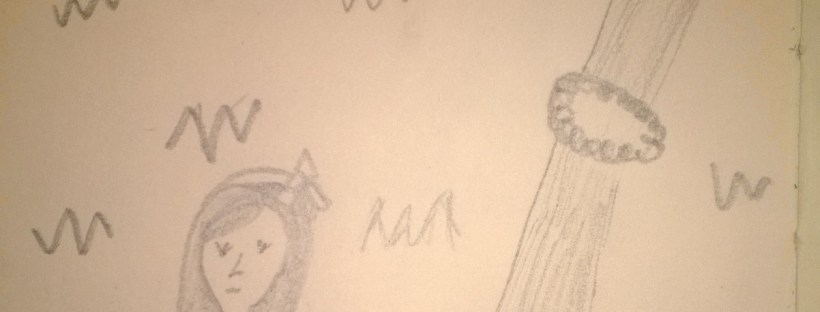
Although a little younger than my aimed audience, my first critic became a nine year old girl who read the opening pages and decided to drawn an illustration to what she had just read. The following is the picture she drew;


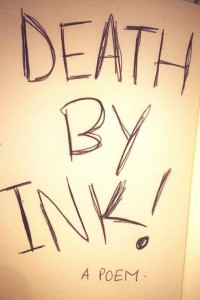
Death By Ink has become one of my first completed poems – it is completely open to interpretation. Enjoy.
Like Birds that have flocked,
to a mind that is blocked,
they would nestle there,
like ink blots.
Blotted ink had stained his thoughts.
You wouldn’t think,
it was bottled ink,
that blocked out his kin.
But then there was that blocked sink.
An apartment like his one would think,
something had died –
Death by Ink.
To think with all this ink,
no mind can function,
with all this irritation,
ink has hurt his skin.
Blots and Dots.
Bottled ink pots.
He stole glances at the clock,
heard no tick but the occasional tock.
The Birds had conjured their flock,
to a mind doomed to be blocked.

Experiencing the role of a Creative Writing student in an undergraduate level – where everything begins to fly your way at the speed of light. You take in the information that has been given to you, but has it really sunk in? You experiment with things outside of your comfort zone, but have you continued this?
You’re still absorbing the environment. You feel new. But everybody’s new. Scanning the room to see what others are doing, gathering influence as you feel the atmosphere beginning to buzz with excitement, amongst your peers, your tutors and secretly yourself. Why? Because you are free to write whatever you want to write, your pen is at the ready. This is your chance to be expressive. But somehow this adds the pressure that what you want to write has to be…right?
Wrong! – There is no ‘right’ when you write. When writing the topic of ‘originality’ cannot be emphasised enough. Not at University anyway. No limitations. No boundaries. We begin our reflections by reflecting on our own writings. The thought of somebody else having to read your creative work slips away gradually. As confidence evolves, so does your writing.
Then there are other writers, perhaps better writers? Maybe not, but they are ‘professional’ writers. The work of these writers we analyse thoroughly. Become influenced, and then incorporate their ideas to our own work. Every word written on a page is thought about, then re-thought about. We interpret meanings, expand onto asking further questions and even link texts together in comparison. Is what the ‘professional’ writer has written a perfect piece. We will never know, only the writer can answer that. What we do know is that the end result is a beautiful one. Why? Because the words just fit together, drawn together and meant to be together like the pieces of a jigsaw. It may take a while to get there, but you do get there.
I.A.


There’s a first for everything. This was the first time I had received a gig like this.
The atmosphere was tingling with passion and excitement as I strolled onto the streets of my first protest. I was the ‘Photographer’ (well it said so on the bib I was wearing). I was part of a team, part of a movement and now that I looked the part I had to play the part. The cold air bit harshly onto any exposed skin, the drizzle from the sky dampened the roots if my hair, dewdrops settling themselves upon it.
The pickets were up! Diving into my role as ‘photographer’ I was lucky enough to capture the emotion that pulsed from these motivated and determined workers. Their devotion towards fighting for what they have been stripped off made my job a whole lot easier, as they thrived upon the inspiring speeches and the support they gained from their fellow workers.
Crowds are great aren’t they? Being able to capture action shots is so thrilling. The angry fist pounding, whistles blowing and shrieking with enthusiasm and frantic banner waving are just a few scenes I witnessed through the eye of my lens.
News crews were all lined up as I sandwiched myself in between them, barely visible but I didn’t miss a second. My all seeing digital eye could reach heights and angles that was not visible to the human eye. The shutter clicked rapidly. It finally ceased fire 362 shots later.
The sun peeked through the dark clouds, almost as if it was showering a blessing upon the crowd, presenting its love and support to the union.
This was fun.

The most awkward moment of every parent’s lives as their child ponders over the mind-boggling situation as to where babies come from. Within my youthful mind, it was the bird that delivered Dumbo who had delivered all the babies of course. He would scoop up the babies from the clouds in the sky and it was the industrial, towering factories we see sitting on the side of the motorways that make the clouds obviously. Then there are teeny, tiny, mini people that live inside the T.V set so we can watch them in our favourite movies and shows. How else would they get in there?
Fear of losing my imagination is something I can’t, well…imagine. Did you ever think that when you were kid your imagination was wild, wonderful and whimsical? Your mind would conjure the impossible. Then enters this buzzkill called ‘growing up’ and your adolescent mind adapts to theories, concepts and beliefs shaping itself to understand the world.
Maybe it’s better not to understand things, that’s how your imagination continues to flow. If you find it hard to see how the world works, view it in a way how YOU would want it to work.
Welcome, I am Iram Ahmed and this is my blog. Involving combinations of photography and creative writing along with a mixture of other creative formats to hopefully entertain, educate and elaborate upon the world and what it has to offer.
Enjoy.
I.A.
 The red lippy chronicle